

How to Get Kids to Listen When You’re Also Their Parent
May 31, 2026
Published On:
May 31, 2026
How to Get Kids to Listen When You’re Also Their Parent
Published On:
~6 min read
You’ve probably been there. You’re standing on the sideline, the field, or the gym floor, trying to get your team’s attention, and half of them aren’t even looking at you. The other half are poking each other. One is doing something completely inexplicable in the corner.
And here’s what makes it extra complicated when you’re a parent-coach: you’re not just their coach. You’re someone’s mom or dad. Which means the usual coaching playbook (establish authority, set consequences, command the room) lands differently when one of those kids goes home with you.
So how do you get kids to actually listen? Not just comply in the moment, but genuinely tune in?
I’ve been coaching young athletes for decades, starting as a 17-year-old speed skater unexpectedly handed the reins to his own team, then through volleyball, track & field, and beyond. What I’ve learned, mostly the hard way, is that the question of how to get kids to listen is really a question about trust. But let me start at the beginning.
The Kid Under the Card Table
My first coaching job arrived without warning. My beloved coach left our Oregon team to take over a program in Alabama, and when the people in charge of finding a replacement came up empty, they grabbed me, a 17-year-old with a whistle and absolutely no idea what he was doing.
I arrived early to that first practice. Prepared the track, powdered the floor, set a card table up on the infield, laid out the stopwatches and starting gun. Hung my whistle around my neck.
I was ready. Except I wasn’t.
I immediately ran into the worst-case version of the ‘un-attentive student’ problem ever invented. As I started my introductory spiel to the team, one little imp crawled under the card table and wouldn’t come out. He was determined to stay under there for life, and I was dead in the water before I had even begun.
Most parent-coaches don’t start with quite that level of chaos. But we’ve all had a version of the kid under the card table, that moment where we realize that showing up prepared isn’t the same thing as being ready to lead.
Stop, Turn, Listen: The System That Actually Works
In the years since that first disastrous practice, I’ve conducted hundreds of first practices. And I’ve learned that your opening minutes with any new group are the most important of the entire season, because that’s when you establish both your authority and your methods of authority.
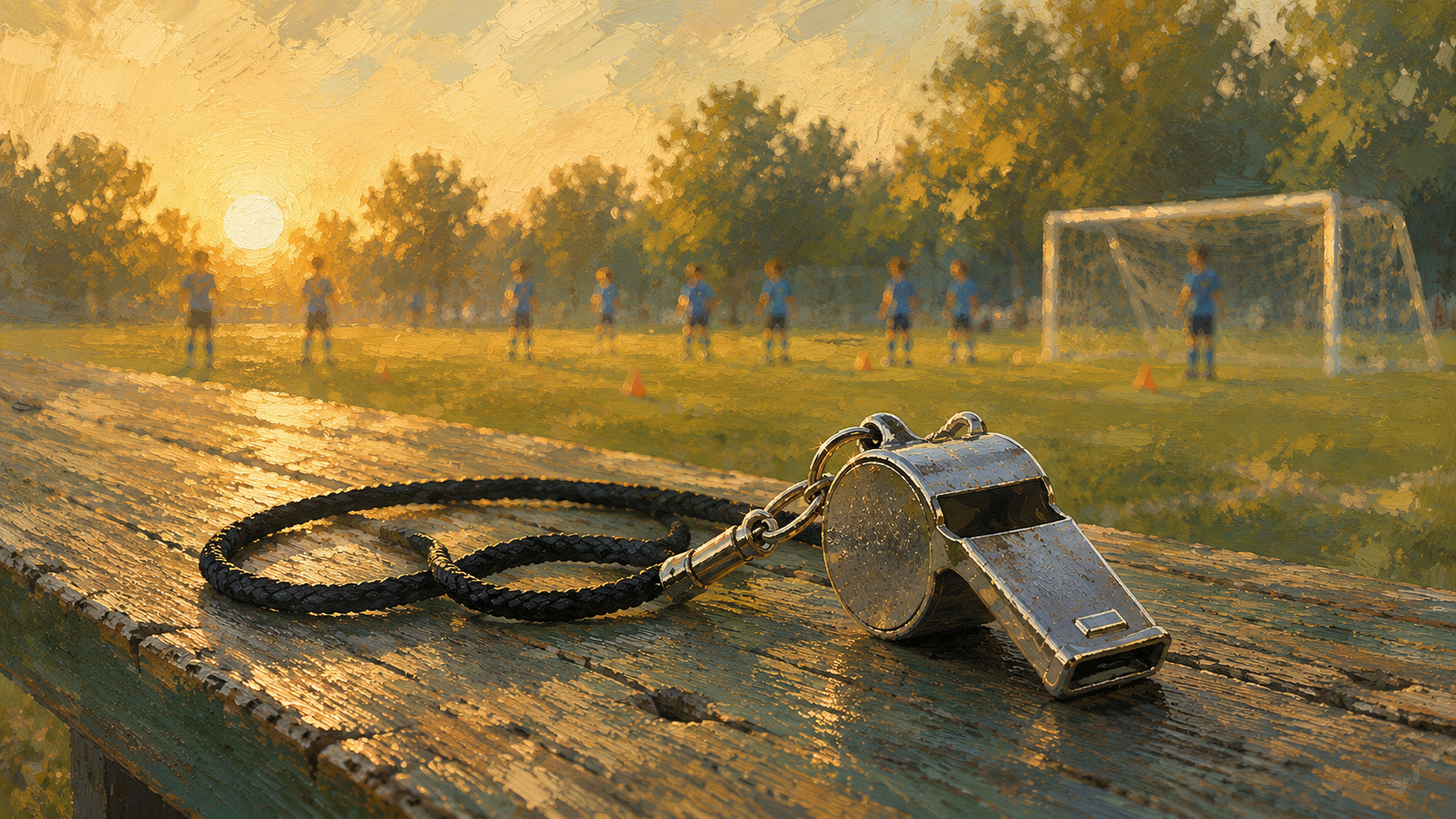
Here’s the simple routine I developed. In as few words as possible, I tell my newcomers that they’ll be taking part in a lot of noisy activity, but there will be times when the noise needs to stop so I can deliver a few words. Whenever I give a signal (in my case, a single blast on my whistle), they stop their activity, turn to me, and listen. Stop. Turn. Listen. I say what I need to say in as few words as possible, and then they resume.
But the routine is worthless without consequence. Any rule needs to be backed by something that establishes your position as head honcho. In my case, the consequence for not following the procedure is temporary removal from the activity. Simple, clear, and enforced consistently.
And then, because coaches are habit makers, I’d run my new group through the routine with enough repetition that it became automatic, not something they had to think about but just what we do.
For parent-coaches, this kind of structure matters even more than it does in other coaching contexts. Your kid needs to be able to separate the two versions of you: the parent who loves them unconditionally, and the coach who holds them to a standard. A consistent, predictable practice environment helps create that separation.
Look at Yourself First
Here’s where I’ll be direct, because I’ve seen this pattern too many times to be gentle about it:
If you’re having a persistent problem getting your students to listen, look at yourself and how you’re delivering your words. If you’re a boring coach conducting boring, ineffective practices, attention problems are automatic. The problem lies with you.
Learning to coach a sport is like learning to perform a sport. You start out as a tottering beginner. And for ambitious people, the kind who are used to being competent and who lead in their careers and communities, that’s a genuinely uncomfortable place to be. Especially in front of your own kid.
The answer isn’t to perform confidence you don’t have. It’s to actually get better at the craft: study the skills of the sport, break them apart, figure out exactly what you’re trying to teach rather than what just sounds right on the sideline. Be interesting. Speak in a vocabulary your athletes understand, and say what you need to say with as few words as possible. Like a carpenter driving a nail, take direct aim and bury it.
This will take time. You will often reach mastery by first getting it wrong. The important thing is to never be satisfied with the wrongness.
The Moment Everything Changed
Early in my career I had a valuable stint coaching beginning sixth-grade volleyball players. In my first year, I didn’t know what I was doing. We won our games, but only because I’d accidentally inherited good athletes. I knew that wouldn’t last.
So I did the work. I took each skill apart the way you’d take a car engine apart, studying each moving part and how they fit together. Then I reduced those skills to teachable pieces and spent the following season drilling correctness with genuine attention to detail. I was a knit-picker. My players pushed back against the monotony. I was leaning on my authority as coach to keep the whole thing on the rails.
Then our first game came around.
The girls on my team unleashed their skills like gangbusters. They excelled beyond their wildest expectations.
That was the moment of opportunity. When we came back to practice after that game, we talked about why it had happened, why they’d been so much better than their opponents. My insistence on correctness, drilled into habit, had made the difference. And with that realization, I no longer had to rely on my authority to keep the approach going. They took personal possession of it. They became their own coaches. The attention to detail spread through the team like a good disease, not because I was the coach wielding authority, but because they trusted an approach that had brought them real success.
What This Means If You’re Coaching Your Own Kid
There’s a particular tension in coaching your own child’s team. You’re holding two roles that pull against each other. As a parent, your kid needs to know you’re in their corner no matter what. As a coach, you have to hold a standard, sometimes a harder one than you’d hold for another parent’s child.
The parent-coaches I’ve seen navigate this well tend to do a few things consistently. They separate the roles clearly, often with something explicit, like marking the beginning and end of practice time, so their kid isn’t constantly trying to figure out which version of you they’re dealing with.
They earn trust the same way I described above: by knowing what they’re doing, teaching it well, and letting results do the talking. Kids don’t need a perfect coach. They need one who’s honest about what they know, committed to getting better, and genuinely invested in the athlete’s development, not just the scoreboard.
And they stay curious about their own coaching. Not just ‘did we win’ but ‘am I getting better at this? Is what I’m teaching actually working?’
The Takeaway
Getting kids to listen is really a question about trust. The mechanics matter, the signal, the consequence, the habit, but they’re just the scaffolding. What holds the whole thing up is whether your athletes believe that what you’re teaching will actually make them better.
Your students must listen to you when you speak. You establish that behavior in the first minutes of the first practice. You back it with consequence and build it into habit.
But if your words and drills and all the other things you teach are correct and effective, if they’re genuinely leading your athletes to success, you’ll develop a trust between yourself and them that makes the whole attention problem disappear.
Trust is the magic word. When you speak, they will listen.
And then, this is the part worth holding onto: they will speak to themselves, and they will listen to themselves.
That’s the goal: not kids who listen to you, but kids who’ve internalized enough to coach themselves.
Worth thinking about, whether you’re on the sideline or at the dinner table.
Article by Ron Cogdill, a seasoned educator and youth sports expert, has spent over 30 years inspiring young minds. As a published author and 7-time national championship coach, he brings a wealth of knowledge and experience to his writing.
